Episode Transcript
[00:00:00] Speaker A: As much as I thought that I was well rounded and you know, I knew what I was doing.
When I went solo I realized I did not know where I was standing. I started off very slow, which I had all this free time that I didn't know what to do with. When things started to pick up, I was wearing all the hats. I was also paying all the bills.
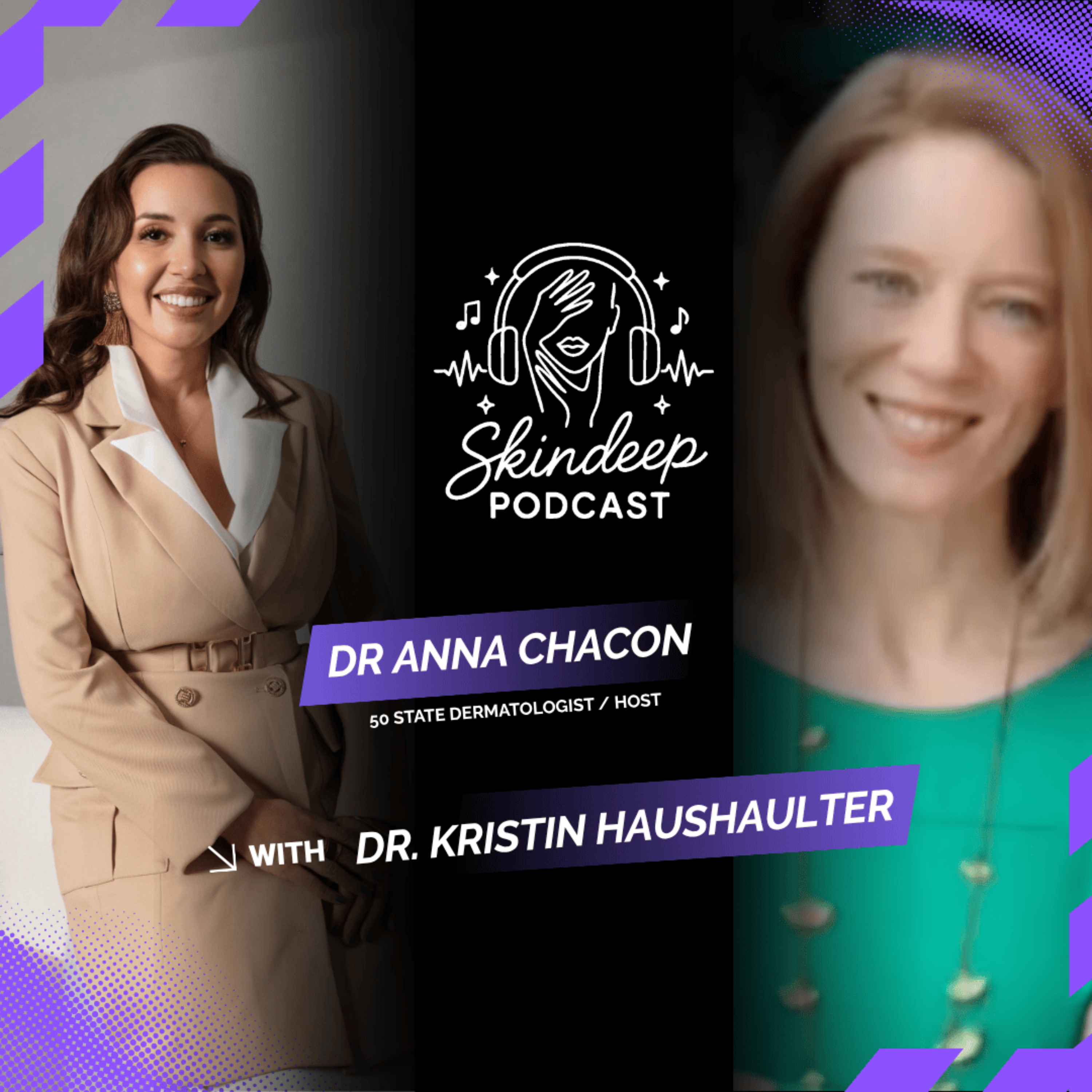
[00:00:19] Speaker B: Welcome to Skindee. I'm Dr. Ana Chacon and today we have a very special guest joining us. Get ready for some expert insights you won't want to miss.
So everybody, welcome to Skin Deep, the podcast about entrepreneurship. This is Ornella Lopresti, world famous esthetician in Miami. She has been around the block in terms of spas, med spas, her own business.
I've known her for about almost two years now and we're working together just recently in the past couple months when a medical assistant left unexpectedly for Puerto Rico, then gave me a two week notice.
Ornella, if you don't mind introducing yourself to everybody else.
[00:01:07] Speaker A: Hi everyone, I'm Ornella. I'm an award winning esthetician. I'm located here in Miami, but I also travel for pop up events. So I often go to Orlando and offer facials there as well. I've worked for a few luxury skincare companies like Clarins, La Prairie, St. Sisley and so many more. And I've been an esthetician for 10 years now with the past three years specifically in med spa settings.
[00:01:32] Speaker B: Tell us about your upbringing in Miami. You are one of the few people I know that went to the, the original, the OG Miami Senior High, is that correct?
[00:01:41] Speaker A: Yes, I did. I went to Miami Senior High and in Miami Senior High they have a special program which I've never heard of before but they actually have cosmetology in a high school setting. So thankfully when I18 I was able to graduate with what's called my full specialty license, which is basically I'm licensed in facials and waxing in nails and you don't need a license for makeup, but I'm licensed in that as well.
[00:02:10] Speaker B: And that was all through Miami Senior.
[00:02:12] Speaker A: High or after that, all through Miami Senior High. I was actually in the cosmetology club. I was the cosmetology club president.
I competed with them as well. I went to regionals and states and that was kind of my upbringing with all the cosmetic and beauty field. The other thing about that is because I was so young and I was just learning, I learned what's the industry standard for everything. So it's just engraved in my head to do everything as if I'm like competing, which is why I'm so meticulous with keeping everything clean, sanitized, organized. Like if a judge is judging me at all moments, just because that's how I learned from the very beginning.
[00:02:51] Speaker B: Yes, you've definitely been a pleasure to work with. That is awesome. I didn't know that they had regional competitions for cosmetology. That is new to me. So that's.
[00:03:01] Speaker A: There's a few of them. They're not too popular, but there's quite a few in the aesthetic, like estheticians themselves know about it, but I don't think the rest of the world does.
[00:03:10] Speaker B: So was that your journey into aesthetics? What happened after high school? Kind of talk a little bit about your journey after that.
[00:03:17] Speaker A: I knew always from the start that I wanted to do aesthetics. But my father wasn't so proud of that. He wanted me to go to college and it was very important for him for me to have like a backbone and something in somewhere along the lines of going to college. So I studied business management and I did business management for three years. I was doing two classes per semester. So I was taking it easy because I also had my full time job. And right around the three year mark Covid hit. And when Covid hit, my life turned upside down.
Everything that was facial related kind of paused, which also meant my income paused. And then for school, it was a transition to do virtual school. So I decided to just pause college at that time. And right after, you know, the dust kind of settled with COVID before the shot. But still during COVID peak era, my previous job was opening up again and they had closed my position as an esthetician, but they opened the position that was a spa manager. So they offered that to me just because they wanted me, you know, to stay with them and have a role in the company. And I think that was like such a nice upbringing for me because it gave me the business side of things when I already knew the aesthetic side of things.
And I got to learn how to manage a team and work with multiple people and budget and do goals and administrative work, events, coordinate, be organized, plan ahead. Compared to last year's goals. All those things that I had no idea with just doing facials and getting contracted for facials. And Covid stuck around for a little bit. I think it was three years before the vaccine came out. And when the vaccine came out, they told me that in order to become an esthetician again, I needed to get the COVID vaccine. And at that moment, I was just kind of waiting around to see what other people were doing. I didn't want to get it right away. So that being said, they gave up my position, and I did have to train the esthetician that replaced me, which was bittersweet because thankfully, I loved her and I was able to pick her out myself. I saw her resume and knew Joe's a great candidate, but it was bittersweet because it was the position I originally wanted. However, she owned a facial spa and a massage spa, and because of COVID she closed that down and went back to a 9 to 5. And, well, from there, she kind of just had this. Kept giving me the idea of going solo and starting off again and just kind of doing my own thing. And she kind of put it all into perspective and tricked me into going solo. I say tricks me, because it was literally just us talking casually and her telling me how to do a strategy of how to open up my own business.
And then it became a dream. And then once that happened, I just started saving every little bit I could to launch and do it on my own.
[00:06:14] Speaker B: And that's when the birth of Fountain of Youth Beauty started, right?
[00:06:19] Speaker A: Exactly. And that's where Fontaine of Youth Beauty emerged from. From really not being able to get my old job back as an esthetician.
[00:06:27] Speaker B: How did you come up with the name Fountain of Youth Beauty out of.
[00:06:30] Speaker A: Everything that came with being a business owner? I think finding the name was the hardest for me. I had already knew the location I was going to go to. I knew my demographic, I knew I had a clientele, I had everything set. And I just couldn't figure out a name. Before, I used to be known as Ornie Mua or Ornie Moi, because my name is Ornella, so they used to call me Ornie. And Mua means makeup artist, but people would also pronounce it as more. So it kind of. It was cute. It was a play on words. But I needed to pick another name, and I really had a tough time with that. And I knew my slogan was going to be your local Fountain of Youth.
And I was telling someone all my business idea and telling them, like, the only thing I'm missing is a name. But, like, this is what I want my slogan to be, my logo, everything.
And they're like, why don't you just name it Fountain of Youth? Like that is. That suits you. It's a pretty name. I do specialize in anti aging and sensitive skin, so Fountain of Youth even went with that.
And I Looked it up. There was no trademarks, there was no llc. Unfortunately, I can't get that name on Instagram, but I can't get the hands on. But it was available, so I went for it.
[00:07:39] Speaker B: So how kind of did you fall into your current med spa position and I guess the audience, how we met. Yeah, what, the dermatologist so far, as opposed to, let's say, working for a spa or any other. There's a lot of places estheticians work at.
[00:07:59] Speaker A: As much as I thought that I was well rounded and, you know, I knew what I was doing, when I went solo, I realized I did not know where I was standing. I started off very slow, which I had all this free time that I didn't know what to do with. When things started to pick up, I was wearing all the hats. I was also paying all the bills. So as I started to. As my clientele started to grow, so did my expenses, because then I had to pay a social media person, some ads, all the different platforms and softwares, the rent, the products. And unfortunately, the more clients I had, the more products I ran out of, as well as just buying new equipment.
So it became a lot of overhead. And it wasn't until. And at this point, I had three locations within maybe 16 months, maybe 18 months. It was less than two years, and I had three different locations just because things kept falling through the cracks.
And on that third location, they raised the rent on me for quite a bit. I was about to start paying 1500 when they raised the rent to 1,500. That's when I was like, okay, I. I need to cut corners somewhere because I have more overhead than what I'm bringing in. And I had to give myself a little bit of a reality check and see what I really valued to continue with and what I didn't. And at the same time this all happened, I had this med spa reach out to me, and they were opening up, rebranding, starting fresh. I really wanted to rent from them, but they didn't want to rent for me. And we kind of help each other out, because in Florida, as an esthetician, you can't do microneedling or certain procedures. You can't use needles or even do some extractions without a medical director.
So they were offering me that medical director title and taking all the hats away from me, right? Because now they had a receptionist, they had all the software, they had everything that was to manage it. And all I had to do was what I loved, which was perform facials, just do the service. It was a little bit of an ego. The reason I didn't want to do it was because I didn't want to hurt my ego. I was so happy to be solo and on my own and figuring it all out. But when I did the math and did the logistics, I just. It was a good opportunity for me and it was the right opportunity. It was the right choice for me to do. So I did decide to join with them. Since then, my clientele has grown so much. It's been now two years and I am able to manage my schedule, have some free time, have, you know, just the flexibility of working with a team for me is really what does it. And I would rather work with a team and have my free time and have my life over, doing everything myself and wearing all the hats and not having that flexibility to, to, you know, hang out with friends if I wanted to, or hang out with family or go on vacation or whatnot.
[00:10:54] Speaker B: Yeah, exactly. And sometimes wearing on the hats, I can tell you, is not fun. You had a space on your head to wear all those hats.
[00:11:04] Speaker A: I give you props because you wear all the hats very well and you have a great team that you lead as well. But I know it's not easy, I guess.
[00:11:12] Speaker B: For some of our aspiring estheticians, what kind of certifications or training is required?
How long is it typically?
[00:11:22] Speaker A: My best advice for estheticians is if you're going to go to a cosmetic school, a cosmetology school, don't fall into debt and get a really expensive one.
All cosmetology schools offer you the same amount of training. The training you really get is when you're hands on in the field, starting off on your own. So the best advice I could give is to find a school that works for you that's convenient, that's not going to break the bank, that works with the hours that you need, whether you do full time or part time, however you need to do it. But once you're done with the course, you'll get that hands on experience by just working in the field and doing your own research and learning from just your experience and then branching out into.
[00:12:01] Speaker B: One of your many talents. Because I know you told me you sold food during COVID too, and I have to try some of your food. You did my hair today and makeup. But you also do social media. And social media has become really important for any business, especially something as visual as dermatology or being an esthetician or aesthetics in general.
Patients often need, you know, before I had you, one of my biggest Shortcomings were there wasn't enough images, imagery of my work in the office.
So how did you get into social media? Kind of discuss that with the audience a little bit?
[00:12:39] Speaker A: Yeah. So when I started, like I mentioned, I had all this free time because I didn't have clients right away. I thought that I was just going to have a fully booked agenda from the start, and I didn't. And I had all this free time, so I would just grab my little tripod or tell my best friend to come over and we just make content.
And then when I was on my phone, anything I'd like, I'd bookmark, I'd send. I'd put it in a folder for, like, potential content to make. When I started doing content, I started to realize what works and I started to count. I started to make strategies.
So instead of just making funny trends, I started to do things that will bring me credibility, bring my brand awareness, and kind of just convert that client. So it became like a little bit of a muse of minor. Like, it would give me a rush to have this idea and actually put it in a video and then post it online and see who sees it and who comments and who likes. When I started doing that for myself, I had friends that were also in the beauty field and they were like, hey, you're doing really well. Why don't you help me out? I helped a couple friends out for free. And eventually I just started saying, hey, if you want me to do this on a regular basis, I can take over. I can manage your account. And before I knew it, at some point, I had like five accounts I was managing while also having my aesthetic business.
At that point, I realized that I really had to narrow down to what I'd love to do, which is facials. And now I just. I rather have a smaller amount of social media clients and really focus on the clients that I have in the spa, which is what I love to do.
[00:14:15] Speaker B: Most popular treatments. You introduced me to exosomes and salmon sperm. I remember when we got a call from, you know, just somebody on the Internet asking if we had salmon sperm, and my medical assistant burst out laughing. Now it seems to be the it that everybody wants on their face.
[00:14:34] Speaker A: Yeah.
[00:14:35] Speaker B: So just trends in esthetician world and aesthetics that you see.
[00:14:40] Speaker A: Yeah. So I think a lot of things are trends. Salmon sperm, also known as salmon DNA, is the closest thing we have to our human DNA. So our skin takes it really well and it has a bunch of healing properties and it's great for recovering and regenerating. Our skin, however, it is very expensive and it does give great results. It is well worth it. But I do think there is, it's not the only solution. You can do microneedling with hyaluronic acid or microneedling with PRP and that gives great results as well. You don't have to jump into the trends just because they're a trend or a hot topic. You can always consult a professional and see what your skin needs over just going with what the trend says.
[00:15:22] Speaker B: If you could use only one product, one skincare product for the rest of your life, what would it be?
[00:15:29] Speaker A: Definitely a tinted spf. If I had to choose one specifically, I would say the SkinCeuticals. I think it's called UV Physical Fusion. It's SPF50, it's tinted, it gives me a nice glow, it wears well all day. I can use that concealer and blush and I'm set to go. And that's normally my day to day skincare routine. I don't need to tell you how important sunscreen is and how damaging the sun rays are. Not only just the sun rays, even if you're indoors, there's UV rays all around us.
So the, the sunscreen is really just my holy grail.
[00:16:03] Speaker B: That would be my, my answer as well.
Some red flags that clients should watch out for in the industry, in the aesthetics industry. It's often a criticized industry to advise clients or patients of.
[00:16:15] Speaker A: Here in Miami, I think people do a lot of things, as we say in Spanish Alexia, that they do a lot of shady things.
So don't be afraid to ask your esthetician to show you her license. There should be up on display in their spa. There's a lot of things that estheticians can and can't do.
Working solo or working for a med spa setting or with a medical director.
Microneedling is one of those things that you do need a micro medical director in order to offer microneedling and anything with needles.
So that's a huge red flag. If you're going to a practice that's not showing the licensing and is offering these medical services without any medical director to really oversee what they're doing medical, then that's, that's a red flag because they could maybe not be trained. A lot of the companies won't sell you these products if you don't have the correct medical director over you. So who knows where they're sourcing, sourcing these products from or if they're telling you the truth about what they're putting on your skin. I mean, with working with Dr. Chuckle. And we have seen people coming from medical for med spas or facial spas, and they'll come with bumps and lumps and they'll say, oh, they injected me with something. So definitely do your research on who you're getting the treatment with. Everything is also online. If you look up someone's name, you can find their license online.
Also, you can always ask them some questions, you know, instead of telling them what you want. Like, instead of going into an office and saying, hey, I want a hydrafacial, say, hey, what do you think is the best treatment for me?
And that will tell you a lot about their credibility and how they read your skin. Those are just some points for the clients out there.
[00:18:00] Speaker B: What treatment, cosmetic or esthetic, would you warn patients about that they should think twice before getting it. And I don't know if you can read my mind, but we've had a couple of these people walk into the office.
[00:18:14] Speaker A: Yes, I am not a big fan of Morpheus for the face. I think it's great for the body, but Morpheus does burn fat, and we want to keep the fat on our face because that's what keeps us young and plump. And actually, when you look at what people call Ozempic face, it's typically that you've lost the fat on your face.
So I don't recommend Morpheus for the face. You can do microneedling, even if some places will recommend Morpheus without the radiofrequency setting. But even then, to some extent, there's always going to be some micro. Some radio frequency. So I would recommend either just micro needling or just anything else over Morpheus on the face. It's great for the neck, it's great for the arms, for the tummy, for the thighs. For anywhere else on the body, I highly recommend it, just not for the face. And then I think you're probably thinking about all the injectables that people do. People have come to Dr. Anna check on with. I think there was a patient that came that got vitamin C injected in her face. And that's just something we don't do, like nobody does.
We've had people get PRP injected in their face and they'll come with lumps. And I don't know if maybe it's the injector's technique or if the injector injected something that's not prp. Not only is this an issue for your face at the moment, because now you have a scar or a bump or whatever, you have to invest Time and money into getting it fixed. And sometimes it'll leave scars that are permanent and cause morbid problem than what you initially came in concerned about. So just really think about the treatments.
[00:19:45] Speaker B: You get out there, favorite treatment to perform and why.
[00:19:49] Speaker A: I've been talking about microneedling all this segment, but I love microneedling. That is my favorite procedure to perform and to receive.
I try to do microneedling on myself at least once a month. Sometimes I can't commit to the downtime because I still want to go to the gym. And you know, we live in Miami, so it's always sunny. But microneedling is my favorite treatment because it helps with everything. Pigmentation, pore size, collagen production, acne scars.
It firms the skin, it does everything all at once. And it really does just transform your skin.
Typically, I recommend a session of three back to back, and then after that you can come every six months more. So for maintenance. What would you say is your favorite treatment?
[00:20:31] Speaker B: I want to say that your facial that you did, where you just massage. I mean, I have not had a massage in so long, even when you worked on me this morning, that it just felt so soothing. Like or no will touch anything. They'll like open it.
You just have like an innate. It's like a massager that you have just kind of built into your hands.
[00:20:55] Speaker A: You know, today when you did your makeup, you were multitasking. So you're on this meeting on video conference, and finally I caught you on a break and I was just like, okay, I started putting moisturizer on you and I just caught you sigh. And I was like, oh, okay, she's relaxed.
[00:21:13] Speaker B: I know it's really hard to get me relaxed. So thanks for your help on that first treatment. So somebody that never goes to an esthetician, considering their first professional treatment, how do you maintain, you know, somebody's skin on a budget?
[00:21:28] Speaker A: I don't think you need to get professional or medical grade skincare to have great skin. There's a bunch of great skincare companies out there in the pharmacy. You don't have to break the bank. I would say go to an esthetician or a dermatologist to get on the right path so that you can understand your skin type. And if you have any skin conditions like rosacea or eczema or anything like that that might be counterintuitive to other problems, products to other ingredients. And then once you get those two sorted out your skin type and your skin condition, then from there you can decide how extensive of a skin routine you want to have because ideally every step is important. But I know not everyone has the time for a 12 step skincare routine. So starting somewhere with a professional and then growing from there, what inspires you.
[00:22:20] Speaker B: And what's the strangest thing that you've been asked regarding an esthetician? Whether it's from a patient or anything like that? Similar to that, I appreciate all my.
[00:22:30] Speaker A: Clients and everyone that comes to me for a consultation. By the way, I do offer complimentary consultations. So if anyone sends me a message and just ask me about their skin concerns, I'm not a dermatologist that's going to diagnose them, but I can tell them like, hey, this is what I see in your skin. This is the skincare you should be using at home. And then sometimes I'll offer them to come in and recommend what service works best for their skin concern.
The weirdest request I got was from a client that DMs me asking for a complimentary consultation. And she said, well, listen, I want to book a facial, but I've never been satisfied with estheticians in the past. And I have cystic acne and I want you to remove every single pimple, but I don't want it to hurt at all. And I am on a budget and at that point I just checked out and I was like, listen, we need to be realistic. If you have cystic acne, I can't remove it all in one day and it is painful. So sometimes I don't recommend you do extractions to cystic acne. Typically I'll recommend a few treatments before we start extracting and they are painful. So we just have to be as gentle as we can with the amount of time that we have.
So to clients like that, you have to know how to set your standards and politely decline to a client. Sometimes we need to fire clients as well. If you attend someone and they give you tough time, you have to make the call to say, hey, this, this client's not right for me, and choose your piece over your business sometimes.
[00:23:53] Speaker B: Excellent. Or you can also tell them about the concierge program where they are allowed to bother us 24 hours a day for a fee.
[00:24:02] Speaker A: Yeah. So you, you have that great concept of the concierge program where if someone has a lot of concerns, they can, you know, pay your concierge membership and they can ask you all types of concerns. Because sometimes we do have those clients that are just very concerned and worried and have a lot of questions and we can't dedicate all that time to them in one visit, so sometimes it's more affordable for them to just do a concierge service. I don't offer that. I have fired clients before. I have had clients that maybe require too much for me and I don't have the attention to offer them. So I will just either refer another esthetician to them or tell them the realistic expectations they can receive from me so that no one is upset. Not me and not the client.
[00:24:45] Speaker B: Well, thank you so much, Ornella, and I think it was great having you on the show, and I really appreciate you taking the time on a Sunday night to speak to everybody.
[00:24:55] Speaker A: Thank you guys, and thank you all for joining. And thank you, Dr. Chuckbourne, for having me here on the Skin podcast.
Sat.