Episode Transcript
[00:00:00] Speaker A: I think probably the most satisfying thing for me building this company has been the fact that I, I managed to solve my own eczema using our solution. So up until two years ago, I was still having very severe eczema flare ups. And so using the, the Symphony as well as kind of the combination of the, of the patient management app which we have, I was able to track my, just kind of everything that I was doing day to day. And so using that as well as my wife, who of course I have to give credit to because she was the main one that was actually able to adv.
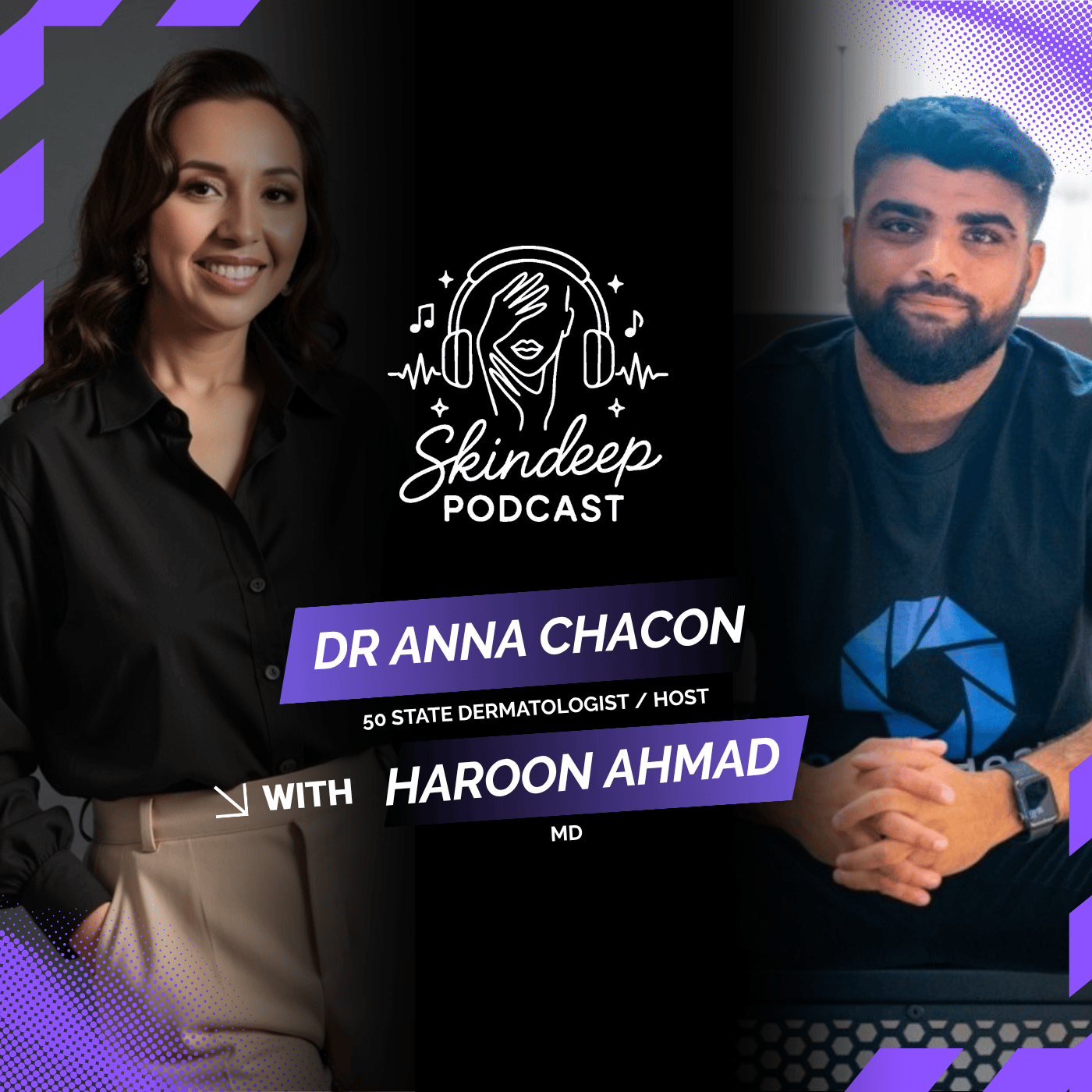
[00:00:32] Speaker B: Welcome to Skindree. I'm Dr. Ana Chacon and today we have a very special guest joining us. Get ready for some expert insights you won't want to miss.
I guess you can start by telling me a little bit about yourself first and your trajectory into kind of health tech and dermatology.
[00:00:51] Speaker A: So sorry, it all started in 1996 without boring you with a year by year breakdown. Essentially. I, at a young age I had quite severe eczema. What that meant was I was exposed to dermatologists from a very young age. And whenever I was going to hospitals I was like, wow, this is like amazing. Like these people are so friendly. I get to play on the PlayStation, you know. So I didn't necessarily have that negative view of a hospital that most children do at the time. And so with that experience, as well as the fact that I had South Asian parents who had an inclination for their children going into medicine, my career was pretty much set right. So to actually become a doctor now, as you'll know, Anna, life isn't kind of always as rosy as it seems. So when I actually go into medicine, and in my third year in particular, where you get unleashed onto the wards, I had a lot of doctors that were teaching me and training me and saying, look, Harun, like you need to look at kind of other career paths as well, that we're not necessarily, necessarily happy, a lot of us are burnout, etc. So that was kind of quite a big culture shock for me that, to think that, okay, this dream that I had of entering medicine and actually becoming a doctor, you know, the people above me and I've been there and done it are saying, actually this isn't probably the path that that's kind of correct or the one for you. And so it was that fact, you know, that I had that experience with those doctors as well as the fact that I was still flaring up with my eczema even when I was a doctor. Which is kind of crazy to think about because, you know, you know everything that there is to know about medicine. I've had this skin condition for years and still I wasn't able to get on top of it. And so it was those two factors that made me think about another career path and to think about how I could actually solve this problem that I had perpetually. And in essence, midway through my med school career, I went off and studied management and that opened my eyes to world of entrepreneurship and health tech. And after that, after practicing as a doctor for a few years, I decided to hop out and start my own company in this realm. So that's how we got started.
[00:02:41] Speaker B: What is your connection with the United States? Just wondering. For some reason, I thought you lived in Texas.
[00:02:46] Speaker A: We recently got investment from techstars, who are a large accelerator across the US and the world, actually. And so one of their cohorts was the techstars physical health accelerator, which is why we were over in the US for the past three months.
[00:02:59] Speaker B: Great. Awesome. And what is the process, just for viewers like myself? You know, I'm kind of heard of techstars, but what's the process for basically getting an investment from them or participating? And what do you necessarily have to do? Do you have to go there in person?
[00:03:15] Speaker A: Each of the cohorts differ in terms of the application process and the way that they kind of do their admissions, but broadly it's a. It's an online application that you do, which involves video pitch, and then from there, if they like you and they're interested and it matches their interests and they'll take you forward in the application process.
Each one has broadly a different theme and they're in different locations within the US So as I mentioned, ours was Physical Health and it was also based in Dallas Fort Worth, but there's other programs for other domains as well as some that are just completely remote. So, yeah, it differs based on the cohorts.
[00:03:50] Speaker B: Tell us a little bit about your journey from being an American academic. I'm sorry, a medical doctor. Did you practice in the UK a lot before basically starting Proton Health or getting into tech?
[00:04:01] Speaker A: Yeah, so I did six years of med school and then practiced for a couple of years as a doctor. And then from there me and my co founder was also a doctor, took a very similar career path to myself. We then started Proton Health.
[00:04:13] Speaker B: Is the co founder still involved or mostly the face of the company?
[00:04:18] Speaker A: Yeah, so my co founder is Niall, who's our cto. So he's actually taught himself to code and so he does all of our technical, the technical aspects of the business.
[00:04:28] Speaker B: What helped you transition from clinical practice to health technology and entrepreneurship? Do you still see patients? And if not, when was the last time you saw a patient? And how do you balance that with being a CEO? That's a question for me as well.
[00:04:43] Speaker A: Absolutely. So I left clinical medicine a couple of years ago. I made the transition. So this was during med school that I had this in my mind that I was, I was going to possibly switch. So before this I was like the kid in the, in the playground who used to sell sweets and make a quick book. So I always had that entrepreneurial bone in my body. But it was really the management year that opened my eyes to the world of digital health. So it's a one year degree. I studied at Imperial for that and that essentially just exposed me to another world because we weren't in a med school, we were in a business school. We were focused on various different entrepreneurial type topics, so accounting, marketing, kind of broader how to start a business. And, and so that's what gave me a great foundation and grounding to be able to hop into health tech. But I think more broadly I just did a lot of reading, so I was reading a lot of books on startups and how to make that transition. And then also the other thing was just using LinkedIn. So I know that you're quite on LinkedIn as well, Ana, but it's interesting. I like to, I saw a few people who had gone down that path where they were physicians and then they'd gone into startups. And so what I like to do whenever, whenever I notice those types of people was I just look to reverse engineer what their career path was, to look at their experiences and what they did get to that stage. And that's kind of how I was able to do that. So I think LinkedIn is another great tool to actually build that foundation and build the confidence to go into health. Step.
[00:06:03] Speaker B: Yeah, I think LinkedIn, it's kind of like a social media for professionals. It's excellent for people who have an interest in that. What is the mission, you would say, of Proton Health?
[00:06:13] Speaker A: It goes back to what I said before about how when I was seeing doctors on the wards, a lot of them were burnt out. And I think that's been a broad trend in health care, whereby now more and more the demands on clinicians are increasing. Right. Our true focus is actually to bring the humanism aspect back into medicine whereby doctors aren't burnt out and patients feel quite hurt. And so look, let me just kind of delve in deep into kind of what I mean by this. What we've seen is that health care is evolving and there's more and more increases in demand, you know, consultation times are decreasing, etc. But that consultation model has been stuck. So as a provider, you're often rushing to get information from your patients. And what that means is that consults now either feel like you're on a conveyor belt and having to kind of churn this out, or the kind of information gathering and the history taking is often outsourced to, you know, kind of quickly hastily trained mas. And so what we know is that we didn't train for this as doctors, whereby we're just churning this out. And that's often why I felt. And so what we've built at Proton Health is a platform called Symphony.
Now what Symphony does is it evolves the way that consultations are done by gathering information upfront and high quality information from patients up front. So it essentially gives physicians a 360 degree patient contact before their patient has even stepped into their office. And the way that we do that is that we send out a patient assessment ahead of time and then patients complete that assessment either via voice or by chat. And so this is something that's dynamic, right? It's able to take a history. Dynamically. The physicians that we work with are then able to receive that information ahead of time. So they know exactly what their patient is coming in with, they understand their psychological state as well as any potential triggers that they have, their skin condition, especially if it's more chronic in nature. And then we hand it over to the doctor, right, to actually do the kind of management, to actually be able to have a normal conversation with patients. So that's essentially what we're doing at Protege and Health is. And with Symphony.
[00:08:06] Speaker B: And then how many years is it?
[00:08:08] Speaker A: We've run the company for three years now.
[00:08:11] Speaker B: Could you explain how Dermax automates documentation and what benefits it brings to dermatologists?
[00:08:17] Speaker A: So Symphony is able to, we take the pre visit history and then we provide this kind of structured clinical summary for physicians. And then using that, we combine that with an AI scribe that we've developed. So we have the information beforehand and then we record a consultation as it's going on, so it's able to listen in live. And then we combine that to create and generate various types of notes. So in essence, we're combining the pre visit assessment data as well as the actual consultation data to generate that paperwork and to automate that for doctors, how about AI?
[00:08:49] Speaker B: So there's, you know, a lot of talk of the role of AI and technology evolving in dermatology over the next five years.
[00:08:56] Speaker A: It's difficult to predict because the pace of change is just absolutely rapid. Where I'd like technology and AI to go is. Is not to go down the route where we're kind of almost at odds with doctors. So I know that this is a common fear. My wife is still a practicing clinician and so often the fear is that AI is going to kind of take over parts of, of a doctor's job. And I really hope that that isn't the case. I really hope that we retain that humanism aspect, which is kind of the beauty in medicine. What I hope we achieve with, by integrating AI into our clinical workflows is that doctors are doing less of the nonsense work. So, for instance, paperwork is not ideal.
[00:09:31] Speaker B: It's not.
[00:09:31] Speaker A: It's not where we thrive. And so that's where I'd love to see AI going in terms of direction, where we free ourselves up to actually do what we were used to, which was actual clinical patient care.
[00:09:41] Speaker B: Yeah.
[00:09:42] Speaker A: As opposed to the nonsense of the work. So ideally that's where I'd like it, like to see it go.
[00:09:46] Speaker B: Future plans, Any new features or expansions on the horizon for Symphony or Proton Health?
[00:09:51] Speaker A: We're currently kind of scaling the product, so we've. We're scaling in various clinics in the US and the uk.
So our main aim is to actually demonstrate the clinical efficacy of what we've built. So that's a primary focus for us at the moment.
[00:10:03] Speaker B: Awesome. And what kind of doctor is your wife? Where does she practice?
[00:10:07] Speaker A: My wife. So she's going down the dermatologist track.
[00:10:10] Speaker B: In the UK or here in the United States?
[00:10:12] Speaker A: In the uk, but we're also considering the us. Awesome.
[00:10:16] Speaker B: Excellent. You said, just to clarify, you went to the Imperial College of London for. Was it a master's?
[00:10:23] Speaker A: So I studied at the University of Birmingham for my mbchb, which is my medical degree, and then in between I took a BSc. So a Bachelor of Science at Imperial.
[00:10:33] Speaker B: And how about medical school and res? Do you guys have a residency there?
[00:10:38] Speaker A: I don't know what the equivalent would be, but we have kind of two years where it's called a foundation. You're a foundation doctor, so you'll rotate around different specialties. It's a paid position, but you'll go around various different specialties for two years before then deciding to commit. And the broad split is either you go into medicine, so you try to apply for a particular medical specialty, surgery or general practice.
[00:11:00] Speaker B: I would say that that's what we call that here is an intern year.
Yeah. And what countries is your app available in?
[00:11:10] Speaker A: We're available in the US and the UK predominantly. And the specialties that we're working with are dermatology and then women's health as well. So they're the two broad categories that we've started with.
[00:11:20] Speaker B: And then how about other countries? Just curious, is it. Why hasn't it expanded to others? Is it a licensing issue, a business registration, or getting licensed physicians, or understanding the healthcare in other countries?
[00:11:34] Speaker A: The kind of easy answer of just the fact that we know the UK and the US very well, so we understand that both of those systems. So that's why we've decided to focus most of our resources at this early stage.
[00:11:44] Speaker B: Are there constant. I'm just curious, maintaining an app, do you find that you have to constantly update technology for that? Like constantly update technology and gather engineers together to work on it 24 hours, or not 24 hours, but on a regular basis or. Because I heard that's one of the kind of major investments in just creating health tech. And I'm sure you work with a number of engineers. How did you kind of meet that team to help you grow?
[00:12:13] Speaker A: We decided to take things into our own hands, actually. So we start off by trying to work with other engineers and outsourced engineers. But the common kind of thinking is if something is fundamental to your business and you really want that in house and you want to be able to change and adapt that, so there is this kind of perpetual argument of kind of outsourcing versus kind of, you know, doing it yourself in terms of technology.
So we chose the. To do ourselves. And so the reason was that just, yeah, for purely control purposes, so that we can amend things on the fly. And so one thing with technology, as I've already mentioned, is it's just rapidly evolving. Right. So. So, you know, one day you'll just get a request and it can be an easy job for you if you know how to code and you're able to yourself, but you know, a longer time frame if you're outsourcing that to somebody else. So for me, the recommendation would actually be, if you're a physician who's to kind of actually build technology and you have a bit of free time, just try to learn to code, actually. And so the barrier to entry is like really reduced now, especially with AI. So one tool that we use, for instance, internally is cursor. So Cursor is a bit like ChatGPT, but it's also integrated with like a coding development, coding kind of platform. And so what that means is you can speak to ChatGPT while speaking to your code and it will literally generate it for you. So I'm not saying that this is the solution and that this will kind of work for everybody, but what I do know is that if you're looking for to create proof of concept very early on, it's something that I just highly recommend. Actually just trying that yourself now because I think that, yeah, the barriers to actually has massively reduced.
[00:13:38] Speaker B: So just to clarify, do you know how to code yourself?
[00:13:41] Speaker A: So, yeah, so me and Niall know how to code. I focus more on the data science side in terms of coding and Niall knows kind of pretty much everything in terms of kind of actual app development, both front end and back end development.
[00:13:52] Speaker B: Okay. Wow, that's awesome. Yeah, no, that's not something I've actually thought about doing or pursued.
[00:13:59] Speaker A: You need to check it out. Anna, to be honest, I can share my mindset with you after, but honestly, it's kind of amazing how much you can actually do now, especially kind of leveraging AI.
[00:14:09] Speaker B: What has been the most rewarding experience in your career so far? Do you see the app being acquired in the future or has that kind of discussion happened? Has anyone approached you with acquiring it?
[00:14:23] Speaker A: Potentially, I think probably the most satisfying thing for me building this company has been the fact that I managed to solve my own eczema using our solution.
So up until two years ago, I was still having very severe eczema flare ups. And so using the Symphony as well as the combination of the patient management app which we have, I was able to track my just kind of everything that I was doing day to day. And so using that as well as my wife, who of course I have to give credit to because she was the main one that was actually able to advise me. She was able to look at my data and actually actually see what might be triggering my flare ups. And also kind of what, what things in my skincare routine were probably flaring me up. And so using that as well as my wife's kind of clinical expertise, I was actually able to become flare up free. And so it's now been two years where I've been completely flare up free. So I have to say that's like, yeah, by far the most satisfying thing is being able to solve the original problem that I had.
[00:15:18] Speaker B: Has it been approached by any companies to acquire it? I'm not sure if you know, but apostrophe closed or somehow merged with hems.
Have you been approached by any companies to acquire it? Is that a possibility in the future?
[00:15:30] Speaker A: It's definitely a possibility in the future. At this stage. We're still fairly early in our process and our growth stage, so it's not something that we're looking, looking for in the immediate term.
[00:15:40] Speaker B: And then just curious, I think techstars, what kind of benchmarks do you have to prove to them as you are doing this process? Like what kind of results for the application process?
[00:15:51] Speaker A: It really does vary. So in terms of kind of actual traction, it can be anything from an idea to. We had, yeah, companies that were just an idea and that just started to actually making kind of significant revenue. So it really does vary. But one thing that we spoke at length with with our managing director was kind of how they make their application decisions. A big thing was actually the team. So looking at the team, looking to see why the team is actually doing what they're doing. So obviously startups are really difficult. So what you want are people who are mission driven and that are willing, you know, have kind of almost a higher purpose for building the company because they're much more likely to stand the test of time and actually pursue it when times get, get rough. So that's kind of broadly, I think, I think that is the main, main kind of thing is actually looking at the team, the expertise as well as their motivations as to what guides their investment decisions.
[00:16:41] Speaker B: How do you balance the demands of being a CEO with being a husband? It sounds like you're a family man, you're very close to your family and as well as your background in medicine.
[00:16:51] Speaker A: With great difficulty, I'd say.
I think my wife has a lot of patience. But I think one thing it's. Is that it's easy to, especially when you're running a startup, it's extremely easy to just continue working late into the night. Right. And so I have been guilty of this, but one thing that I make sure that I try to do is I carve out some time in the evening each day to have that time with family. But yeah, it's not necessarily easy to achieve.
[00:17:15] Speaker B: How much time would you say you've put into this or that you put onto it in a weekly basis?
[00:17:20] Speaker A: I actually work more now than I did when I was practicing as a physician. Right. And so I think you'll know this and as well kind of running, running your own practice, quite frankly, kind of a lot more hours. So. But I would say that the hours I do spend I find quite satisfying because it's almost like when you're building something yourself, there's just a different level of satisfaction there. So I enjoy it a lot more than when I was practicing clinical medicine.
[00:17:44] Speaker B: How can people get involved with Proton Health provide feedback on Symphony, including dermatologists, but also the general public? Is this something you have to download on the App Store? Is it free? Is it, how much is it?
[00:17:58] Speaker A: So one thing I haven't mentioned is that so we've mentioned Symphony, which is kind of the our dermatologist platform, which allows kind of pre visit assessments and generates a precise clinical summary for dermatologists ahead of time. But the other thing that we have developed in the past two years is a patient self management app. And so that is it's entirely free to download on the App Store if you're looking for it. It's called Skin X and so just type that into the App Store. It's free to use. And the purpose of that, just to kind of go into that slightly, is that we enable patients to track their skin condition on a daily basis and then we use AI to start to help them figure out what might be triggering their skin condition. And we also have things like self management advice, so basic lifestyle recommendations as well as mental health sessions within the app itself. So free to use on the App Store. Just search for Skin X and then for dermatologists who are interested in using our platform, you can reach me either via my email harun proton-health.com or just catch me on LinkedIn.
[00:18:53] Speaker B: Okay, awesome. Well, excellent. Thank you so much for coming on the program.
[00:18:57] Speaker A: Amazing. Thanks a lot for having me. Anna, Sam.