Episode Transcript
[00:00:00] Speaker A: I mean, Anna, honestly, that's the biggest reason why I decided to create Dermhub. You know, tech is coming for health care whether we like it or not. But I created this because I think physicians should be the ones leading the health tech field, not tech entrepreneurs. Instead of them hiring doctors as advisors and then discarding them whenever they want, it should be us hiring the software engineers to build the technology for us. And then we should be running the show.
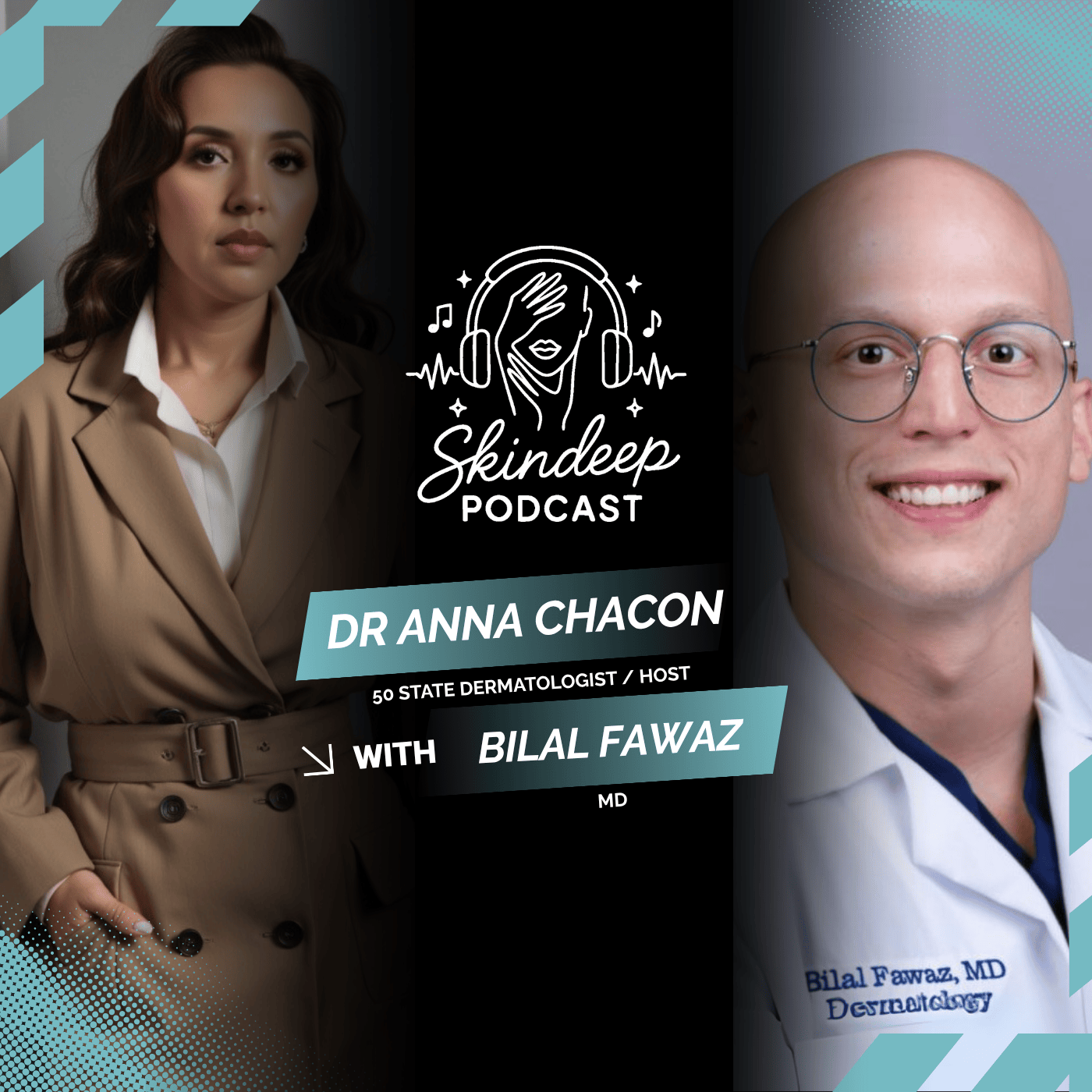
[00:00:28] Speaker B: Welcome to skin deep. I'm Dr. Ana Chacon and today we have a very special guest joining us. Get ready for some expert insights you won't want to miss.
Go ahead and introduce yourself. So, Dr. Fawaz, thank you.
[00:00:43] Speaker A: My name is Bilal Fawaz. I am a board certified dermatologist and the associate program director in the department of dermatology at Boston University. I'm also the founder of DermHub, which is a mobile telederm app that is created and run entirely by dermatologists. And thank you so much for having me.
[00:01:06] Speaker B: Tell us a little bit about DermHub, where you can find it, where you can download it and how old it is, your steps through the creation.
[00:01:15] Speaker A: It's very brand new. It's now on the app store. Anybody can go and download it right now. Our providers are only licensed in Massachusetts to Texas and Florida, which is, I'm sure you know, Anna, is an important clarification to tell people hoping to, you know, eventually recruit more dermatologists and eventually cover, you know, all of the US it utilizes store and forward technology which for the people who aren't familiar with that term, it's when patients answer some questions, upload images, and then the doctor reviews it at a separate time and then shares the personalized diagnosis and the treatment plan at a different time with the patient. And then they can communicate via chat feature to answer any questions that the patients have. Usually our turnaround time is one to two days. Often it's a lot quicker than that because I'm very eager to test it out and get people to use it. And we can prescribe medications electronically to any pharmacy.
[00:02:17] Speaker B: And then tell us the hurdles you faced in doing this. I'm sure you know, there's some doctors interested about getting into the telehealth space or building an app. What are some of the unforeseen expenses and hurdles that you had that you told me about?
[00:02:33] Speaker A: It is complicated and very time consuming, especially when you have a full time job to do this. It's also very expensive. I approached it by, you know, just kind of dividing it up into more digestible pieces.
So when I, when we first came up with the idea, you know, I broke it down to steps one through, you know, 10. And so the first step was to get my ideas on paper and I hired a designer to help me come up with sketches. And then after that I tried to find a developer. And I was lucky enough because one of my really good friends, he has a very successful app called called Toothpick that's based in Dubai and he's a dentist, so he kind of knows what I was trying to do. And I was fortunate because he wanted to expand into the telemed space and he had a team of developers ready to go that ended up helping me out with this project. So I was very lucky in that regard. And he had an entire, you know, design team, a marketing team, just a fully functioning app. He has two apps now actually that are doing really, really well and they've expanded into like six, six or seven different countries around the Middle East. So I had that in my corner to help me out. And then the most challenging part for me is honestly managing US laws and regulations because everything here is highly regulated. HIPAA compliance was a huge issue for me. I researched it for six plus months and any quote I would get would be $50,000, $60,000 for people to help me. You have to hire a lawyer that was really expensive, like a HIPAA compliant lawyer.
And I ended up finding a consultant that put me on, put me in touch with the right people and eventually got HIPAA compliance at a way more affordable rate. I think dealing with the U.S. laws and regulations have been the most challenging part of it and the most expensive part of it. And you need a good lawyer that, that specializes in healthcare and you just have to spend a lot of time honestly doing research on all these things to make sure that you're doing things the right way. The E prescriptions was another hard part of it for me because a lot of E prescription softwares were just very, very expensive. And all of this is self for me. It was self funded so I needed a more cost efficient way of doing it. And so ultimately I ended up finding those spots, which is what was, which was within my budget. But the biggest advice I have is, you know, break it down into more digestible pieces, have a budget in mind and, and keep on doing research until you find services that are within your budget and then have, you know, talk to people around you, talk to anybody, you know, that's in this space that can help you. My connections have Been have been the only reason why I've honestly been able to do this within my budget.
So I've just been lucky in that sense.
[00:05:26] Speaker B: Just curious, how much would you say it costs to develop overall and recurring costs? Because I'm sure there's one of the things with apps is there's a lot of recurring cost.
I'm sure with updates and things like.
[00:05:40] Speaker A: That, app updates, I think it depends on where you end up doing it.
So in terms of recurrent costs, you need your malpractice insurance, that's big one. You need your HIPAA compliance, which is often, often like a software or service that you're paying year yearly in each one of these is in the four to $5,000 range a year. And you need a market marketing team, obviously. And in terms of rough estimates, it depends on whether you have development in house and whether it's in the us that's the biggest part. I'm originally from Lebanon, so I was lucky enough to have a team of Lebanese developers help me out with this project. It was a lot less expensive than it is to do it here in the US And I was lucky because they had already had a lot of experience because they had two fully functioning apps already. But in terms of recurrent costs, it's probably around $20,000 a year. But to get it off the ground, it's a lot more than that and it's just very variable and it depends on whether you have a US based team or a broad based team.
[00:06:48] Speaker B: And in terms of working at bu, because I know I've worked at Cleveland Clinic and I feel personally, you know, now I'm in solo practice, but a lot of things are sometimes seen as a conflict of interest.
Did you kind of form a separate contract with them? I guess. How did it work with you being an entrepreneur on the side?
[00:07:07] Speaker A: That's a great question.
I've been lucky because the chairs have been very supportive and I think a lot of people within Durham recognize that this is much needed technology.
And so people have been very supportive of it. And, and I've been lucky because that chair, The Pioneer Chair, Dr. Rodolani, and even the current chair, Christina Lam, they've been very, very supportive and they basically have allowed me to do whatever it is I want with this on the side. And I've been very, you know, upfront with them about it. We're, you know, formalizing, you know, an agreement just to have it on, on paper, but they haven't given me any resistance.
They've only been very supportive. I think that's unique and I haven't let it affect my, my job. I still, you know, practice full time, I see patients full time. I have a few admin roles as well as the associate program director.
And so that's still my priority. And I've managed to have time, you know, on the side and on weekends and after hours that I've been working on this project during. But they've been just very, very supportive. I don't think that's going to be the case at every academic institution, but they've just kind of let me do whatever it is I want.
[00:08:18] Speaker B: That's very unique, I would say.
[00:08:20] Speaker A: So. Yeah.
[00:08:21] Speaker B: And then tell us a little bit about the Toothpick app, because when you said there was an app for, for dental, I can't imagine that because I feel like dentists are more hands on even than dermatologists. So what, what exactly does this app do and how is it able to succeed so much?
[00:08:37] Speaker A: You can think of it more as a dental marketplace. So it's kind of like the Amazon for dentists.
So it started off marketing directly to dentists where they can buy supplies through the app. It's a marketplace for all kinds of office supplies essentially. So you can see how it can extend to any field within medicine. But that's how it took off.
And so now they're in charge of logistics and supplying all kinds of dental offices in like seven, six different countries.
And they either have been very successful with a lot of sales, but they're in charge more of logistics as a marketplace. And, and now they're expanding to a finance. They basically finance a lot of the dental procedures. They have like a toothpay option, they call it Toothpay, where you can finance any sort of cost at the dental office. And so they're expanding into other services, but that's, it's basically a marketplace for dentists.
[00:09:32] Speaker B: That's great. I actually think that should almost exist for dermatology because, you know, McKesson, their way of ordering is actually quite backwards.
And I still have to text the rep and you know, hey, do you have this? Because it's just so hard to find something, you know, something in like iris scissors. And you just, you know, you can get anything and everything in there and Amazon is not any better in terms of medical supply chain stuff. And it's very essential and you could get ripped off very easily.
For example, I'm considering buying a laser now and just it's all over the place, you know, from things in Korea to things in America to use yeah, you can't. Does something even work? What is the warranty? You know, it's just so very difficult. So, yeah, I think a centralized marketplace is very essential. And we talked a little bit about when you and I first met about ZocDoc.
One thing that I see with telehealth is kind of a.
This takeover where it feels like, you know, these telehealth companies start with dermatology oriented items.
Apostrophe was one of them.
[00:10:44] Speaker A: Right.
[00:10:44] Speaker B: Then they expand, and then they just really start cutting corners regarding what they're even offering. So now HIMS and hers or HIMS has cut them out entirely after purchasing them. A lot of their patients left. In fact, a lot of them came to me and, you know, now they're, they've taken away a lot of their product offerings, just away entirely. And are focusing on basic things like tretinoin. But. And we talked about how a lot of times in telehealth physicians are seen as just collaborators.
[00:11:17] Speaker A: Right.
[00:11:18] Speaker B: And they're cheaper and cheaper and they're just kind of feeding into this whole. Yeah. Thing.
[00:11:25] Speaker A: Yeah. I mean, Anna, honestly, that's the biggest, biggest reason why I decided to create Dermhub. You know, tech is coming for healthcare whether we like it or not. But I created this because I think physicians should be the ones leading the health tech field, not tech entrepreneurs. Instead of them hiring doctors as advisors and then discarding them whenever they want, it should be us hiring the software engineers to build the technology for us, and then we should be running the show. And it's primarily because it's the medicine part that's hard, Right? Not the technology. Anybody can come up with technology where you can answer questions, upload images, and then chat with somebody. The only way to get good at Telederm and to provide exceptional care is to do it a lot. And in the cases where you're not 100% sure you want to bring them into the clinic, you want to correlate your remote assessments with your in person findings and the biopsies, case after case, until your accuracy sharpens over time. It's that feedback loop that makes you a better clinician. And sweat differentiates good care versus great care. And you speak to a huge issue here because tech companies often try to skip this, right? They skip the clinical experience and they just come up with protocols that are standardized for everybody. Or they hire mid levels that don't really have the experience that we do.
And we've all seen what happens when tech companies are led by people that don't have grounding in ethics or service. And we just healthcare, we can't really go. We can't afford to go down that route. And so unless physicians step up and then leave the space, I worry about a future where a lot of the decisions are driven by profits, not patients. And so we need to take a more active role. And it's a big part of the reason why I did this and I started this and I've been lucky because at BU we do have a pretty robust econsult service and we've treated, you know, over 7,000 patients to date, all the way back to 2019.
And I all the credit goes to Dr. Jack Bawan who started this back in 2019, even before COVID And so a big part of the reason why I started this too is because I saw how, how effective telerm can be if it's done the right way. And I built this app to try to expand that level of service past academic settings, so to more patients all around the US essentially. But we need to be more in charge is essentially what I'm trying to say.
[00:14:00] Speaker B: That's excellent. And so you have an econsult service. We also had1@usc. What platform is used there? I'm just curious.
[00:14:09] Speaker A: It's through epic. And so what happens is other providers from all around the institution can submit, you know, cases. They answer some questions, they upload images of the patient concern, and then we tell them essentially what to do. And the providers are the ones that are in charge of communicating with the patients.
So it's efficient for us, it's a really good service for them because oftentimes they have to wait a year for the patients to be seen in person. So the turnaround time is a lot better and you're still able to deliver high quality care in an efficient manner. And for the persons that you feel like you need to see in person, you just have them come into the clinic and then you're able to follow up those people in clinic and do biopsies if you need to manage them. If you need phototherapy or biologics or anything, you always have that option to refer them for an in person appointment. And it's often expedited compared to just a general referral. So I do think that's kind of the future within dermatology. I think be the ones triaging the cases, not anybody else. Like that's. And this is the only way, I mean, storing forward technology is the, you know, it's scalable, it's efficient, it's accurate. There have Been a lot of studies that show that it's diagnostic accuracy matches in person, so 80 to 90% of cases. So it's the main way that I see us improving access to care without sacrificing quality because otherwise patients are just, you know, relying on these direct consumer skincare brands or Google or mid levels and frankly it's just not the same level of care.
[00:15:43] Speaker B: Correct. And you can't teach, you know, 12 years of school in like the year and a half that that's impossible. You know, it's dermis sometimes, hard as it is and you can't cram that in for someone that didn't do a residency. You touched on a lot of important points. Just curious for this econsult system right now, for, for the dermhub, it's all self pay. And we talked about when you first met my struggle, insurances and getting in and the fact that you need, if you were to do this on a national scale, you need an address in every state. It could be a virtual address but you need one and you need to pay for one. You know, it's. No one's going to give it to you. In terms of the econsil system. Just curious that bu. Do you guys code insurance for that? How is that?
[00:16:27] Speaker A: It's that four, four.
I forget the exact. But the telephone communication, I think it's 4, 4, 5, 1. I forget the exact. But yes, we build insurance. I mean half the insurances don't pay, you know, half of them give you like 40 bucks or 50 bucks. So it's not really.
We do it just as a good service for patients. I think it's just undervalued as a service. And the reimbursement model for this needs to be improved because it's the main way that we're going to improve access to care. We need to start valuing, you know, judgment based care just as much as procedural care. Otherwise it's no surprise that a lot of derm trainees want to go into cosmetics and nose. Right. It's a very lucrative process and until telederm starts to match that in some way, shape or form, it's not never going to match it completely obviously. But until we give them something that is feasible for them financially and that's somewhat equivalent to seeing patients in the clinic doing biopsies, doing procedures, it's going to be very hard for us to fix the access to care issue because we don't have enough dermatologists. Right. And we're not training more anytime soon.
So to me the store and forward Telederm specifically is the only way to fix it. But the reimbursement model needs to be adjusted and insurance companies need to get on board with this too.
[00:17:50] Speaker B: Does Apple make you pay every month to keep your app up?
[00:17:53] Speaker A: I'm assuming not every month. It's a yearly thing. So it's the App Store and the Google Connect. You have to pay like 100 bucks a year or something. So it's not, not, not too much. The other thing that I've run into is, you know, every state you want to, if you have your LLC registered, you have to pay randomly. Like $500 a year. Just for funsies. Like, I don't understand it. They're like the state just sends you a bill once a year saying if you're a business in Massachusetts, you have to pay $500 and the same thing for an app. For a business in general, not just for the app. Like for you to be running a business in Massachusetts or in Delaware, you have to pay what they call a filing fee every year.
[00:18:35] Speaker B: Yeah.
[00:18:36] Speaker A: So negligible. But it seems kind of unnecessary for me.
[00:18:40] Speaker B: But yeah, it's bureaucratic and so that's interesting. Did you have to do foreign filing of the app? I'm sure that is Germ Hub, your own LLC registered in Massachusetts?
[00:18:52] Speaker A: It's in Delaware. That's just what the lawyer recommended. But we have to also file an annual report in Massachusetts because it's operating in Massachusetts as well. Because I'm like providing services within Massachusetts, but it's technically registered in Delaware.
[00:19:08] Speaker B: Yeah, I actually had to do that as well for telehealth and things like that. Yep, I had to do that.
[00:19:13] Speaker A: You've worked with a few different companies that at this point now, what's been your experience with all these like telederm companies? Do you. Did you feel like you were adequately compensated? I just kind of interested to hear more about your perspective because I'm sure that you probably felt like you weren't compensated as. As well as you should have been.
[00:19:36] Speaker B: Yeah, of course. I mean, it's, you know, the liabilities really lies on the physicians. A lot people don't realize this. As we talked about and different examples I gave you how much liability there is in being a physician doing something the wrong way. And some of them just pay very little and you're taking on quite a bit of risk. You could try to justify it in the sense that, you know, like, I will always have a lot of work because of the 50 licenses. You know, if I just wake up you know, there is a lot of work, but at the same time, if one of those things goes wrong or you break a law in a certain state, the consequences are sky high. And, you know, I've seen that happen. Like, for example, Himss, you know, we talked about it. They paid doctors very little. You know, I think when I was at apostrophe, some consults were as low as $5.
I'm not even kidding. $5 for an education that cost me, you know, more than half a million dollars. And some of them compensate for. For licensure and things like that. And they give you a large volume. But that can be seen as bad, too, because the volume that sometimes you're seeing at these telehealth companies can draw red flags for that physician, whether it's at the pharmacy or on a regulatory level. And so how do you balance all of that with just the cost, the exorbitant cost and years that it takes to be a physician? And then the competition that they have in telehealth is just hard to balance. The other thing is very important, that having a lot of the licenses does make you a liability. For example, if there is malpractice somewhere, you have to declare it on every renewal, and you better believe that it's going to open up an investigation and delay your renewals. And then you have to declare on all the other states, okay, well, I have this going on because this happened. And then that, you know, a lot of times you have to get legal advice on that, and then that adds to more expenses because then your attorney, if they could be saying, okay, well, you need an attorney in each state, because I don't know the laws or I don't represent or I don't know anybody on the board in that state. So it just really gets very difficult. And because of the changing laws, I don't find also that the boards, for example, or even the dea, like Telehealth, even Medicare doesn't like Telehealth, you know, because of all the schemes that have happened. So if there's something that is deemed as a red flag, you're going to be judged more harshly, and then that actually will follow you. So, you know, a telehealth company can open and close and go bankrupt or sell or whatever, but a physician's career is not like that. You make a mistake or you, you know, you're held accountable for something, and it will follow you until the day you die, unfortunately. And a lot of these people that form these companies, they only have one thing in Mind profits.
Sometimes they just see physicians as a way to achieve that.
[00:22:43] Speaker A: Right.
[00:22:44] Speaker B: They don't really care. You know, the moment you have that sort of mark on your record, you are usually, you know, discarded actually, just, you know, I know telehealth physicians that have just been pushed aside and then, okay, well, we got the next one who's going to be the new chief medical officer or the new this or the new that. And you know, it's important to note that, you know, the telehealth companies, you know, they could come out in the news, but very few people knew who the key decision makers are behind these names. Right. Very few people know that. Whereas if you have a mark on your record as a physician, you better believe that there's going to be press releases about that. It's going to be in the news, it's going to be in newsletters, it's going to be disseminated everywhere. Some patients will even create, like in California, they'll create websites on what happened and they'll add you to that website and you'll have a page for yourself or whatever it is. So it's very difficult to deal with those sorts of repercussions.
So yeah, no, I do not think the compensation is what it should be for the level of liability that you take on.
[00:23:58] Speaker A: Yeah, I mean everything you said is so true. And again, I think basically goes back to my earlier point, which is why I think we should be the ones in charge, not a bunch of business minded people. But how do you deal with the stress of having 50 different licenses? Anna, that's just so much paper Network too.
[00:24:16] Speaker B: Yeah, I'm used to it at this point. I have, you know, I have a, a virtual assistant that manages all the renewals and like notifications and all that stuff. And I get notified and it's just really my business. And I, I could, you know, as to your point, I could make more with cosmetics, with MO and things like that, but I valued things a little bit differently. I really wanted to work from anywhere when I mean that I wanted to not be chained. I always lived wherever. No matter what job I did, it always seemed like I lived very far away from where I was working or there was enormous traffic. You know, I've lived in LA and Miami, I've even lived in New York City. Just the effort that it took for me to just get to work was sometimes difficult. And I just really wanted, you know, to open up a computer and be able to get, get somewhere, you know, and I like working online and like the point you mentioned, the online world is just not going away. I mean, we see stores closing, you know, Forever 21 went bankrupt this week. Stores that were doing really well. And that's kind of translating a little bit in healthcare. You know, there's still some things that you. I do have an in person right now. It's actually not very profitable. It's actually a headache to run, mostly because of insurances. But I do believe in in person care and we do triage people to be seen in person. Like we let them know that not absolutely everything can be done online. You can't have a cyst remove online, you can't have a full body skin check online, but at least you can have, I believe every moment is an educational moment with the patient and you can educate them on even things that they can't do online. And then they can take that information and learn from it, you know, or what assist is and they can read about it. And that way when they come into office, they're prepared for the procedure that they're going to have. So it could be used to triage things.
I don't see it as a waste just because somebody needs a procedure in the long run.
[00:26:17] Speaker A: 100%. Yeah. And we've done studies on this actually, because we've had so many patients and 70% of cases were able to manage things remotely. And then in that 30%, we end up referring them for an in person visit. So that's still the vast majority of cases that you're able to handle remotely. And I'm sure you've been in this scenario, Anna. Like an example is yesterday I was at a dinner party with really good friends of mine and it was eight of us. And then four out of the eight had some sort of a skin issue that they wanted to talk to me about and then two of them needed actual prescription.
So to me, this is a really good use case for the app because instead of having them get their contact info, have my staff reach out, have them come in person, have a chart, have them come in. It's like, okay, you just download this app, answer some questions, upload an image, I'll prescribe it electronically. It's easy for everybody. It makes our life a little bit easier because whether you like econcepts or not, as a dermatologist, you're going to be doing it, you're going to be doing it for the rest of life. Your, your life. People are going to text you images all the time. Friends, family, friends of friends of friends, other doctors. You know, you're going to. You're going to be doing inconsults forever. And so this is way to do it in a HIPAA compliant, easy way for both of. For both us and the patients.
[00:27:36] Speaker B: Yeah, correct. And then the other thing that's important is telehealth really changes a lot and sometimes other people are a little bit slow to adapt to that. You know, certainly an expensive business, but you know, looking back, all of medicine is actually a very expensive business. You know, going to school is. You're taking on a lot of expenses, cost and risk, you know what I mean? Same thing with licensing. I do sometimes feel with, and just in general as a physician that you almost can't stop working because too many places are depending on money from you, basically fees from you, like malpractice insurance, these foreign filing things.
Everybody kind of just by you being a physician, you already give people a lot of work and a lot of money and income, not to mention all the staff that you work with at the hospital, they're there to support you. But a lot of the positions wouldn't exist without physicians, you know what I mean? And so it's just, I think they need to lower things like what you were talking about, filing fees and. Because actually $500 is a lot when you multiply it by several states. And I'm definitely learning this the hard way with legit script certification and things like that. It does add up to be a lot. So I think, yeah, I like exchanging ideas with you and I think you and I are on the same page with a lot of things. And I do think there's a way we can continue to develop this. Maybe involving insurance, getting LegitScript certified, keeping up to date with regulations, and even involving a marketplace like what you were talking about with your friend and Toothpick. I like all those names. Toothpick, Toothpaste. That's very creative.
I feel like I have to download it to see what it's about.
[00:29:30] Speaker A: They've done a great job. I do think it's needed in the US too. The technology exists. We can easily, you know, set up a meeting with them to discuss this further. I think it'll be a bit harder in the U.S.
because the companies, it seems like a few companies have like a monopoly on this where you directly go to them and you have to go to their websites. I'm not as involved in the management of the office supplies, but it would make sense that a marketplace would make easier. Would make things easier for everybody that's in the medical field.
[00:30:04] Speaker B: Yeah, I know because with McKesson, which is, you know, one of the leading companies, it's been definitely very difficult to even order anything but. Awesome. Well, thank you, Dr. Foas, and have a great rest of your weekend. Thank you for being with me on a Saturday morning. Any kind of parting thoughts for our audience, which mostly are entrepreneurs, other physicians, and some patients?
[00:30:27] Speaker A: I think we just need to take a more active role in the health tech field. I think we need to collaborate with each other. I always very much enjoyed Talking with you, Dr. Chacon, and bouncing ideas off of each other. And I think we need to support each other in this space so that people outside the space don't ruin it going forward. So that's kind of the main thing. Please reach out to me if you have any questions or concerns or anything more that you want to discuss.
I'm always happy to collaborate with anybody out there who's. Who's willing to do some telederms. So you just kind of reach out if you have any issues or anything you want to talk about.
[00:31:04] Speaker B: Thank you so much. Nice to see you.
[00:31:06] Speaker A: Next. Nice to see you. Have a good one.