Episode Transcript
[00:00:00] Speaker A: But now if someone, a physician mid career looking to transition out of clinical practice asked me that question, I would say it depends because you don't necessarily need a degree unless the degree really adds something to your value on the market or your skills that you're going to apply directly in something that you have a clear objective for. So it's not necessary for a position to get an MBA to become entrepreneurial, for example.
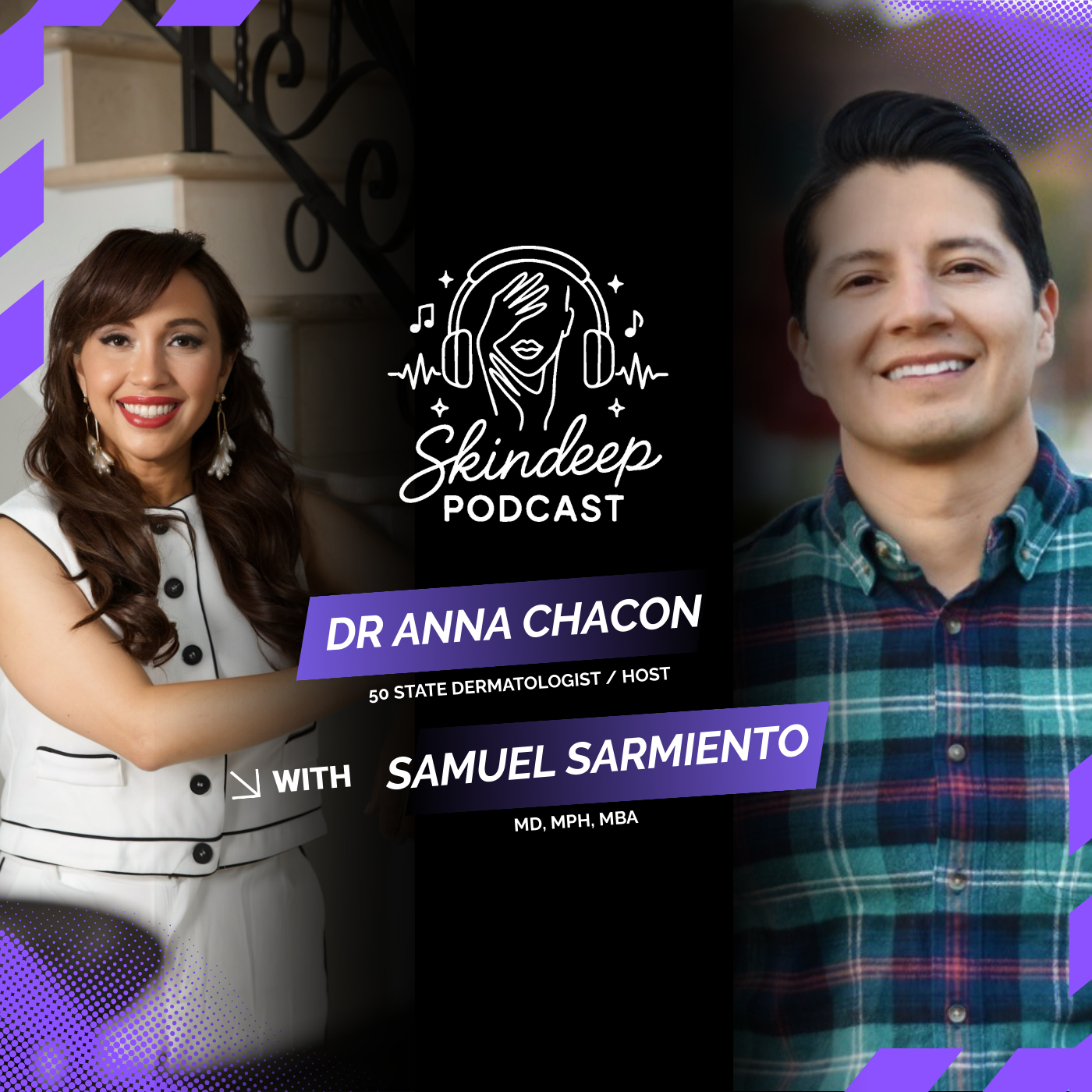
[00:00:27] Speaker B: Welcome to skin view. I'm Dr. Ana Chacon and today we have a very special guests joining us. Get ready for some expert insights you won't want to. Ms.
Samuel, if you can please introduce yourself to the audience and talk a little bit about yourself, your business, where you're from, how you got to where you are.
[00:00:49] Speaker A: It's a pleasure to be here, Anna. Thanks for the invitation. I'm originally from Ecuador and I moved to the US a while ago. I was first an exchange student here and then I came here for my medical training. My background is in surgery. I did my internship at Mayo Clinic. However, early on I realized that a clinical career path wasn't the right fit for me. So I decided to look for non clinical career options. And that took me to public health first and then to business.
And while I was in business school, I was exposed to the world of consulting and just to a different thought process, a different way of approaching problems. And I realized that I could apply my background in healthcare in a different area. So that's how the idea came about for me to start providing consulting services.
I started first as an independent consultant and now I have a small boutique company that provides strategy consulting in the life sciences. We work with clients broadly in healthcare and for me the focus is primarily health and wellness companies, for example, supplement companies and also some biotechnology companies, especially some digital health companies, for example, companies that create apps that have a health purpose.
[00:02:07] Speaker B: What was it that made you think that you didn't want that clinical path?
[00:02:12] Speaker A: For me back then, I don't think I even have the words and I don't think I had enough clarity to realize that what I was experiencing during residency was my body just not feeling comfortable with the experience.
It just now I look back and I realized it wasn't aligned with my values. I remember, you know, getting to the hospital on a Saturday and having to be there for 24 hours and just feeling miserable, knowing that I would have to be there when I wanted to do something different, when I wanted to be outside or spend time with my family or focus on other things like, you know, writing or pursuing other passions. I have.
So that made me realize that perhaps that wasn't the right place for me. And I also noticed in my specialty, especially in surgery, general surgery in particular, there was a lot of burnout. Early career, mid career, and late career burnout. And I just didn't want that to be me. I think I'm lucky that I realized early enough that perhaps the transition to something that's more aligned with who I am and would give me greater satisfaction. And now I look back and I realize that it was the right decision.
[00:03:22] Speaker B: Are you from Ecuador, you said?
[00:03:24] Speaker A: Yes, I'm from Ecuador.
[00:03:26] Speaker B: Did your family play a little influence in your decision? Did you do also residency in Ecuador or partly in the United States? Kind of. How did you split your training and your background?
[00:03:38] Speaker A: Yeah, so, yeah, my family, everyone is in Ecuador still, and I maintain a strong connection to my country. That's when people ask me where I'm from. I'm a US Citizen now, but I always say I'm from Ecuador. My father's a physician, and he was a big influence for me to go into medicine in the first place.
And I did medical school in Ecuador, but I came to the US for residency, and then I also did some graduate education in public health and then in business.
I also did a fellowship at Johns Hopkins before venturing out of academic medicine and into the consulting field.
[00:04:16] Speaker B: Had your dad done consulting too, or. Just curious, what kind of physician was he? Because my dad is also a physician, but he had never done. He had actually never done a virtual visit or telehealth, unlike me.
[00:04:29] Speaker A: Yeah, no, same with my dad. He's actually in primary care.
He was a primary care doctor, but he's also dabbled in things like naturopathy and homeopathy. He has an interest in complementary. Complementary health practices. And I was actually exposed very deeply to that growing up because that's what we used at home, in fact. And no, he's. He's never done anything like consulting. He had a very traditional practice. He had a private practice. In fact, his entire career was in private practice. And he saw patients in the office and very traditional doctor patient relationship in primary care.
[00:05:07] Speaker B: How did you come up with the name Juniper Life Sciences?
[00:05:11] Speaker A: I was in San Diego, California at the time.
And of course, you know, the juniper tree is present there. But the inspiration was actually, it actually came from one of the bishops that founded the first California mission, which was San Diego de Alcala, and his name was Junipero Serra.
So. Junipero Serra in English. So the inspiration for the name actually comes from that. That. That's the, you know, the origins of San Diego. And I was there when I started the company, and that was actually the influence for it. But later, you know, it was also good to have juniper in the name because of the resilience of the juniper tree. So it turned into a nice logo. And also it fits well into a life sciences company.
[00:06:00] Speaker B: Public health and business administration. What. How did you pursue those? Were they worth it? You know, there are a lot of doctors that get these degrees. They're very expensive at times. What did you learn per se, and do you have any regrets or were they very helpful in what you do day to day?
[00:06:17] Speaker A: Yeah, I know more doctors are pursuing degrees like MBAs. That's becoming more common. And here's my take on it. For me, you know, each trajectory is unique. For me, the way I did it, sort of not knowing where I wanted to go after clinical medicine, I had no clue. And I think the transition for a lot of physicians is daunting, even when they're dissatisfied in the medical profession, because it's unclear what the path might look like when you go outside of the clinical arena. For me, it was both uncertainty about what I wanted to do, but also curiosity about both public health and business. And in fact, I knew I wanted perhaps to try public health as a way to transition out of clinical medicine, but business was almost by chance. In the process of researching schools to do my public health degree, I realized that some of them offer dual degrees with, for example, Master's of Business Administration or a JD or other degrees. And I thought, well, combining this work with business seems like an interesting opportunity and also a very efficient use of my time getting two degrees in half the time, essentially.
So I thought it was an interesting combination. And I had no expectations because I had no experience in business. But now if someone, you know, a physician mid career looking to transition out of clinical practice asked me that question, I would say it depends, because you don't necessarily need a degree unless the degree really adds something to, you know, your, your value on the market or your skills that you're going to apply directly to in something that you have a clear objective for. So it's not necessary for a position to get an MBA to become entrepreneurial, for example. And in fact, they have some peers who have started businesses who don't have degrees in business, so that's not a requirement. But for some people, it might be an opportunity if they're considering a career, for example, in public health or consulting, because an MBA does make you a good manager and also A better fit for opportunities like, you know, traditional consulting and healthcare.
[00:08:26] Speaker B: What are some of the biggest challenges? I almost want to ask you, you know, does anyone help you out with your company? Do you have other staff or do you kind of single handedly do everything on your own? And how do you balance, how do you balance running a business?
[00:08:40] Speaker A: Yeah, because it's such a small business and maybe you can relate with your own practice. You of course, have to wear many hats and, you know, you have to be on top of, you know, different things in your business.
I do have a small team of consultants. So it's less than 10 people total.
And we all specialize in the life sciences in some way. Some people have backgrounds in public health or in medicine because most of the projects we get, nine out of 10 projects we get are specifically related to health and medicine.
So having people who understand that aspect is a requirement. And then I think an added benefit is to have people who also understand the business aspect of healthcare. That's a real advantage for the work we do because oftentimes clients come to us because they look for expertise in medicine or the sciences, but they also want someone who can take that and help them, you know, grow their businesses or develop better products.
So it's important to have a combination of the two.
[00:09:49] Speaker B: Did you teach yourself six languages?
[00:09:52] Speaker A: Yeah, I, I, I love languages. So when I was talking about not having t time to pursue my passions during residency, that was one of them. I love languages. I actually have learned five languages as an adult. So, you know, Spanish is my native language. English I learned as a teenager. And then as an adult I taught myself five languages.
And sometimes people ask me why or what's the secret to learning a language? And it's really, you have to put in the time and you have to make it something practical, something actionable, something that you're going to use.
Because most people, if you ask them, they say, I would love to learn a foreign language, but they don't really want it because there's no practical use in their lives. They don't make it something, they don't make it a priority in their lives.
Whereas for me it's a passion and I love it. It's allowed me to connect with people better, to have more authentic experiences when I travel to understand cultures more deeply. So it's been a benefit all around for me.
[00:10:54] Speaker B: Do you travel a lot to try to use them or how do you try to use the languages?
[00:11:00] Speaker A: So in fact, some languages I speak I have never used in the countries that speak them. I just like languages, but for some other languages, I've had the opportunity to travel to countries where they're spoken and I've used them there and it's completely changed my travel experience. For example, I was in Europe and I was in France and in Italy. And being able to essentially, you know, visit as someone who can understand the culture a little better because I'm having conversations with locals or I'm going off the beaten path to, you know, to places where perhaps not a lot of tourists venture into because I speak the language. So it's been a huge blessing for me. And, you know, it's. It's really paid off to put in the time to learn those languages.
[00:11:45] Speaker B: What languages are they?
[00:11:46] Speaker A: Spanish, English, French, Italian, Portuguese, German. And now I'm learning Dutch.
[00:11:52] Speaker B: Wow. Okay. So European based. Yeah, I. It's interesting. I was in. I used to be a belly dancer in a previous life, in college, at college and high school. And then I learned like Arabic just because of the music, you know, to try to kind of. But it was just so hard. So I really admire that. Yeah, that's amazing. What tools do you use for them? Do you kind of use the same tool online for all five of these languages?
[00:12:18] Speaker A: What I use, in fact, is here's my approach, because language learning is different in the adult than in children.
And sometimes people ask me, you know, what's a method? What's the secret? Does duolingo work? Does this method work or not? And the thing is, there's no other way around using the language as soon as you can and as often as you can.
And the way I approach it is, for me, it's important to have like a rough understanding of the language first.
So, you know, for maybe six weeks to eight weeks, I'll focus on understanding the basics of the grammar of the language, you know, building some basic vocabulary, knowing how to construct basic sentences. But as soon as I have a grasp of that, I start using the language. And one tool I use, which I always recommend to people, because you don't always have the opportunity to meet up with someone who speaks the language. So what I do is I use a tool called conversationexchange.com and it's really simple, low tech. You create a profile and you meet with people who are practicing your language and then you create these, what are called tandem exchanges with them, where you meet for an hour and you speak your language for half an hour and then their language for half an hour, and you really commit to doing that, to only using that language for that period. Of time. And that's. It's really challenging when you're just learning because you feel like a child. You can't express anything, any complex ideas, your vocabulary is limited, maybe you say everything in the present tense, but that's exactly how you learn. And if you don't find those opportunities where you're challenging, where you feel like what you have to do in that moment is one level or slightly above your current competence, you're not going to learn. You have to feel uncomfortable in that way to learn a language.
[00:14:14] Speaker B: Any resources, books or mentors that have been particularly influential in your journey as an entrepreneur?
[00:14:21] Speaker A: I would say people like Tim Ferriss. I don't know if you know him, he's an author, podcaster. He's actually one of the OG podcasters and one of his areas of focus is business because he's an entrepreneurial investor. So he's very much in that world and he's connected with the who's who in business and investments in the world really. So he's been a really positive influence for me to understand more about the path of entrepreneurship and how unique it is for, for everyone. But also motivation to just take action. Because I think sometimes we're paralyzed by the magnitude of the or the complexity of actually carrying out an idea. But I've gotten motivation from people like Tim to just do it, take it one step at a time and execute on your ideas and literature.
There's so much literature and actually some books that I'm found inspiration in are not necessarily business books, but books in, in other areas. I would say, for example, Marcus Aurelius Meditations, where he discussed Stoic philosophy. It's essentially his journal where he just wrote down his thoughts and ideas and his view of the world at the time. And that has been, you know, big inspiration for me to also pay attention to the important, important things, be more engaged in the present, enjoy my life more in the moment without, you know, worrying too much about the future.
[00:15:51] Speaker B: What advice would you give to other physicians, other health care professionals considering a transition into entrepreneurship, or who feel burnt out from clinical medicine or just exposure, looking for exposure to the business side?
[00:16:05] Speaker A: You need some time to get that clarity for yourself. So anything that can facilitate that might be the first step towards transitioning to something that you find more fulfilling. And, you know, it might be something different for different people. It might be a different specialty for some who really love medicine and want to stay there. But for other people, it might be something, you know, completely different. It might be entrepreneurship, it might be something like their own business. For others, it might be consulting. So whatever you are considering, the only way to get clarity on what the best path might be for you is to understand yourself better first. So what I would recommend is take some time off. And I mean physicians, I think they do have that luxury, if they plan it correctly to save enough money to be able to live off those savings for a few months. And I know at different stages in their career they might have more responsibilities like families and mortgages and so on. But you, I think it's so important to create that time, to create that space, to think deeply about what you want to do, to reflect on who you are, what your values are. Maybe you can meet with a coach at that time to help you get that clarity so that you, you can make the best decision for yourself. Because maybe entrepreneurship isn't for everyone. But whatever you are considering, I think if you have that time for, you know, deep thought, I think it's more likely that you'll make the right decision. And it's so important because I've met so many colleagues and maybe you have two who are really dissatisfied in medicine but don't know what to do outside of it. So anything that can help you take time for yourself, breathe, get back to the basics, just take good care of yourself, of your health, and then engage in the process of deep thinking can help you with, you know, a future move.
[00:18:02] Speaker B: What trends are you seeing? Any projects that you've had like significant impact on and then long term goals and then how you foster innovation and creativity just in general.
[00:18:14] Speaker A: So the first part of your question was what trends I'm seeing? AI is the biggest one. And I'm sure, you know, all of us are exposed to it now on the personal side, on the business side, and I'm just keeping an eye on it and keeping abreast of the developments in medicine in particular. I think it's going to affect medical practice in many ways. In some profound ways, I don't think it's going to replace physicians. My hope with AI is mostly optimistic. I hope that it makes clinical practice safer, more efficient, that it helps to reduce burnout for physicians, that it helps to reduce administrative burden.
That's really, I think, the best case scenario for AI and future plans, future directions for myself in the future. I think I will want to explore other areas too. In five years, for example, I do see myself doing something more creative. For example, I love that you're taking the time to do things like this and I want to be doing something like this I don't know if it'll be a podcast or books or how I can contribute, but I'd love to also put out more of my own creative work into the world as opposed to doing work for hire, which is what I do a lot of now. When a company hires me for a specific project, I want to be doing more creative work for sure. And I also have an idea to have something like a holistic healing center in Ecuador where I'm from.
Something that integrates not just physical health, but also mental well being and spiritual well being. That's a plan I have.
[00:19:48] Speaker B: Awesome. Well, thank you so much. Thanks.
[00:19:50] Speaker A: Thanks again.